
by Katelyn Shu, ʻIolani School Global Health student
Teacher: Mrs. Nan Ketpura-Ching
This past week my classmates and I have been fortunate enough to participate in a COVID-19 Variant Trackers Project with ʻĀina-Informatics. Viruses like SARS-CoV-2 are constantly mutating and changing into new variants. When the highly contagious delta variant came to Hawaiʻi, the resulting surge during the summer had COVID case numbers higher than ever before. Part of the job of someone who specializes in bioinformatics is to use computer tools to analyze biological data, which can be used to learn about these variants and how they spread around the world.
We began the project learning a little bit about how SARS-CoV-2 is sequenced to find the order of the nucleotide bases that make up the RNA. Many runs are taken to be more accurate. If when it’s being sequenced, a base doesn’t match up with the reference genome, it could be a possible error or mutation. The method of sequencing we were able to see with ʻĀina-Informatics was called Nanopore sequencing, where DNA goes through nanopores that detect electrical changes with sensor arrays. These signals can be read by a flowcell device. We were provided with different samples of swabs from people who contracted COVID-19 during June-July 2021 on Oʻahu. Some of my classmates got to use micropipettes to put the samples into the flowcells.

Taking a closer look at a MinION flow cell.
Photo credits: Eric Wehner
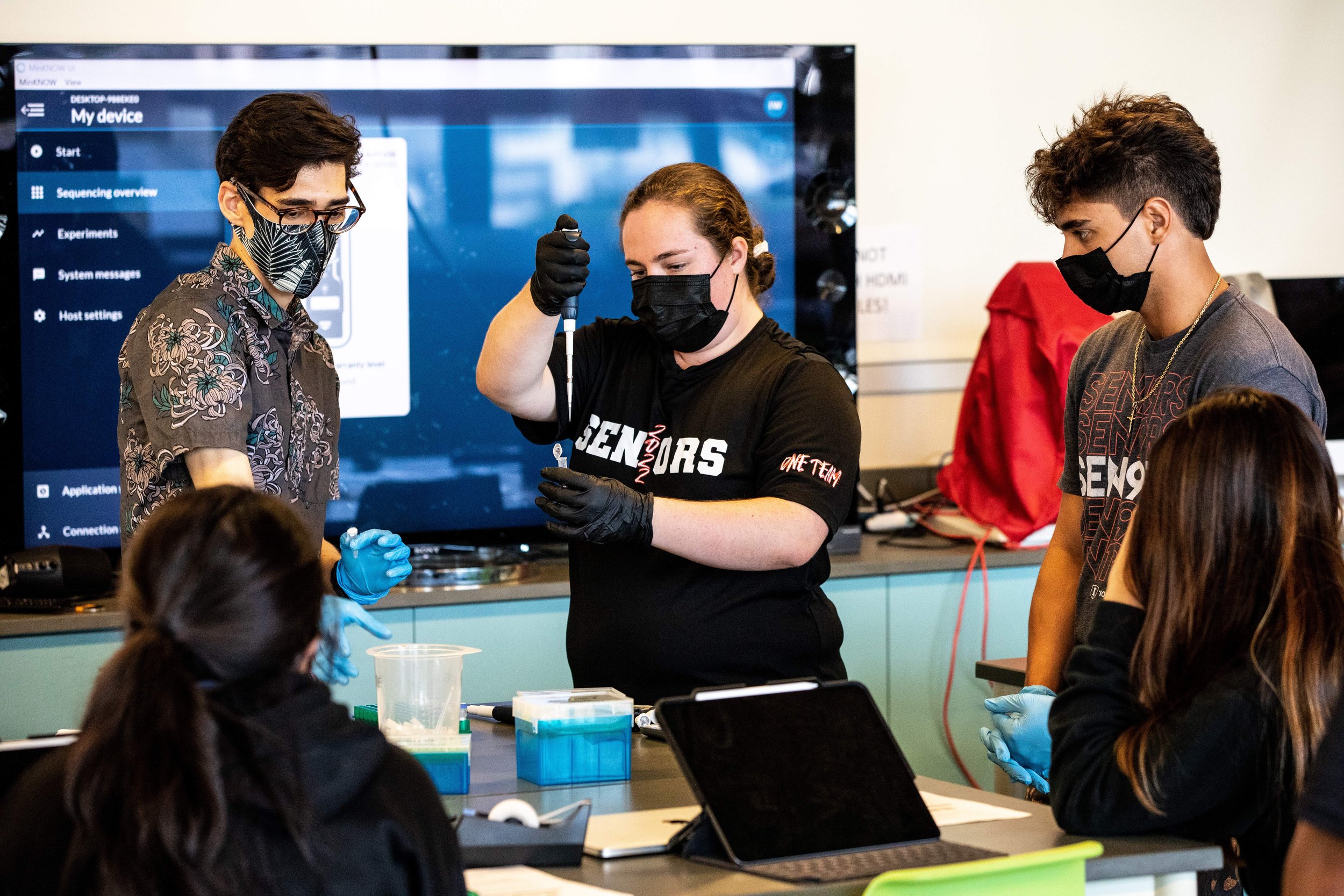
Priming the flow cell for sequencing.
When we returned later, we were able to learn about the programming tool called RStudio. Biologists use RStudio to do complex statistical analysis. Using this tool, Mr. Tong helped us create a “family tree” of sorts for the spread of COVID-19. It’s really fascinating. By sequencing countless nucleotides and tracking the mutations, biologists can track how variants travel based on the similarities between the COVID genomes of swabbed people. I was so fascinated to look at the family tree that was generated. In the end, our references showed that most of the samples we found were the Delta variant. A few others were Alpha or Gamma, but there were no samples from the original Wuhan strain nor the Mu and Beta variants. This fit our hypothesis that most of the samples would be Delta.

Variant assignment of genomic reads in RAMPART.
Photo credit: Eric Wehner
On top of the contact-tracing we learned about during the epidemiology unit, these programs can truly reveal a whole new side to the broad spectrum that is biology. While others interview people and try to piece together correlations between infected people, people in bioinformatics have extremely important jobs as well in biologically mapping out the path of the pathogen.